Laurens Boekman’s exile
Hans Brinker, or The Silver SkatesLaurens Boekman’s exile is the long separation between a son who believes he has caused a death and a father who knows he has not. After mistaking an error in dispensing medicine for an irreversible crime, Laurens flees Holland and lives in Birmingham as Thomas Higgs. The watch entrusted to Raff Brinker preserves a route back to his family, but it takes years for its message and the truth of the supposed death to reach Dr. Boekman. The eventual reunion resolves the misunderstanding without restoring the life Laurens left behind: he returns to Amsterdam as a merchant, not as his father’s medical assistant.
The Error and the Flight
Laurens had been working as Dr. Boekman’s assistant when he portioned out the wrong medicine for a patient. The medicine was a deadly poison, but Dr. Boekman discovered the mistake before it was administered. The patient nevertheless died that day, and the coincidence left Laurens believing that his error had caused the death. Dr. Boekman, delayed by other serious cases, did not reach home until the following evening; by then his son had disappeared. The difference between what Laurens feared and what had actually happened—an error caught in time—became the central fact he could not know while away.
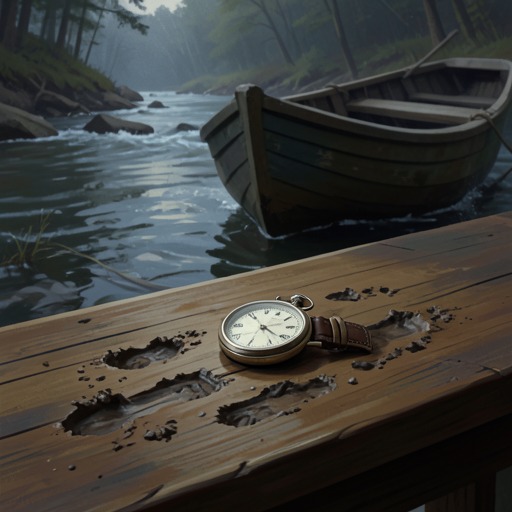
Before leaving Holland, Laurens encountered Raff Brinker, who was working on a line far from Amsterdam. Laurens asked him to take him down the river, explaining that his situation was a matter of life and death. Raff was no boatman and initially objected to helping someone evade the laws of his country. But Laurens insisted that he was innocent, and Raff, moved by his appearance and plea, rowed him perhaps six or eight miles. Laurens then said he could continue on foot. The encounter turned Raff into an unwitting link between father and son: he helped the fugitive leave, but also accepted the object that would later make a return possible.
The Watch and the Unsent Message
Before stepping from the boat, Laurens entrusted Raff with Laurens Boekman’s watch and asked him to take it to his father after a week. The message was to say that Laurens was leaving his country against his will, that he trusted Raff, and that he would face the consequences and return if his father ever wanted him to come home. Laurens also began to give Raff an address for the reply, but Raff could not retain it. In his recollection, the meeting remained vivid in fragments: the young man’s face, his evident distress, and the moment he opened the watch, removed something, and kissed it. The practical detail that might have enabled contact was lost.
Raff never delivered the watch as promised. His memory of the encounter was incomplete, and, when it returned years later, he still could not recall the father’s name or where a letter should be sent. The watch therefore carried both a promise and the mark of a failed attempt to fulfill it. When Raff eventually told the story, the missing message remained consequential: Dr. Boekman had spent the intervening years without knowing that Laurens had trusted him with a message or that his son had been waiting for a sign that he could return.
Thomas Higgs in Birmingham
In Birmingham, Laurens lived under the name Thomas Higgs and established himself in business. He had appeared there as an eighteen-year-old apprentice, learned his trade, and gained the confidence of his employer, who later made him a partner. After the employer, Willett, died, Thomas Higgs took over the business. His rise gave him a settled public identity, but did not disclose his history: the people around him could not establish where he came from or even what nationality he was.
The uncertainty became a local subject of gossip. Neighbors speculated about his accent, his family, and his connection to Holland; they noted that he seemed attentive when Holland was mentioned but could not readily answer their questions about the country. His English name encouraged conjecture, while his reserve and unfamiliar background made him an object of continuing suspicion. The rumors say more about the community’s appetite for explaining a stranger than about Laurens’s life: they had no knowledge of the medical mistake or the father from whom he had become separated.
That guarded existence was abruptly interrupted when a foreign-looking letter arrived. According to the account circulating in the neighborhood, Thomas Higgs turned pale, went to his factory, spoke briefly with a senior worker, and left with his belongings without bidding anyone goodbye. He paid what he owed, but his sudden departure fed the very speculation that had long surrounded him. The episode marks the collapse of the identity he had built in Birmingham and the beginning of his return to the story of the family he had left. The evidence does not establish the letter’s contents; its importance lies in the immediate departure it prompted.
Reunion and a Different Future
One snowy January day, Laurens went with Dr. Boekman to visit the Brinker family. The household had been looking forward to the possible arrival of Thomas Higgs, while Raff was resting, Gretel Brinker tended the hearth, Dame Brinker spun, and Hans Brinker studied by the window. The visit brought the formerly hidden identity into the open: Thomas Higgs was Laurens, the son Dr. Boekman had believed lost to him. The return also gave Raff the chance to complete, however late, the delivery he had failed to make years earlier.
The watch helped establish what Laurens’s flight had obscured. Its case held a paper bearing blue forget-me-nots, and Dr. Boekman recognized the image as the portrait of Laurens’s mother. Raff recalled that Laurens had removed something from the watch and kissed it before handing the watch over. Dr. Boekman understood that his son had kept the portrait; he also explained that the poison had never reached the patient. The news transformed the supposed crime that had driven Laurens away into an error whose fatal consequence he had imagined. It also disclosed the emotional cost of the silence: Dr. Boekman had not rejected his son, but Laurens had fled believing himself responsible for a death and unable to return.
The reunion does not simply restore the earlier arrangement. Dr. Boekman is glad to have his son beside him, yet Laurens has had enough of assisting in medicine and wants to become a merchant. He plans to sell his factory and open a warehouse in Amsterdam. His exile thus ends in return, but not in a reversal to his former position. The family recovers its relationship while Laurens chooses a different occupation and future.
Narrative Significance
The episode gives the domestic story a delayed revelation: the watch, first accepted by Raff as a private trust, becomes evidence connecting a frightened fugitive, a successful English factory owner, and a father who has waited years for his son. Each link depends on incomplete knowledge. Laurens mistakes a patient’s death for proof that his error killed him; Raff retains the watch but loses the address; Dr. Boekman cannot answer a message he never receives. The separation persists not through a deliberate severing of family ties but through the consequences of a mistaken belief and a message stranded in memory.
The plot also makes Laurens’s assumed name both useful and costly. Thomas Higgs enables him to work, rise from apprenticeship, and take over a business in Birmingham, yet the identity offers no way to correct the original misunderstanding. His eventual return reunites him with Dr. Boekman, but the final choice of commerce over medical assistance shows that restored family ties do not erase the years apart or dictate what Laurens must become. In the novel’s broader design, his story connects the Brinker household’s ordinary acts of trust and remembrance to the larger travel-and-domestic narrative that presents Holland through both its people and its places.